Prompting that works
The answer is only as good as the brief. Four parts to every prompt, and one follow-up at a time.
The brief, not the tool
“Write an email to a supplier about a late delivery” produces a stiff, generic email that mentions nothing real. That is not ChatGPT being bad at emails. It is ChatGPT being told nothing.
Think of it as a skilled temp on their first morning. It can write, summarise, plan and calculate. It knows nothing about your business, your customer or what happened yesterday. Your prompt is the handover.
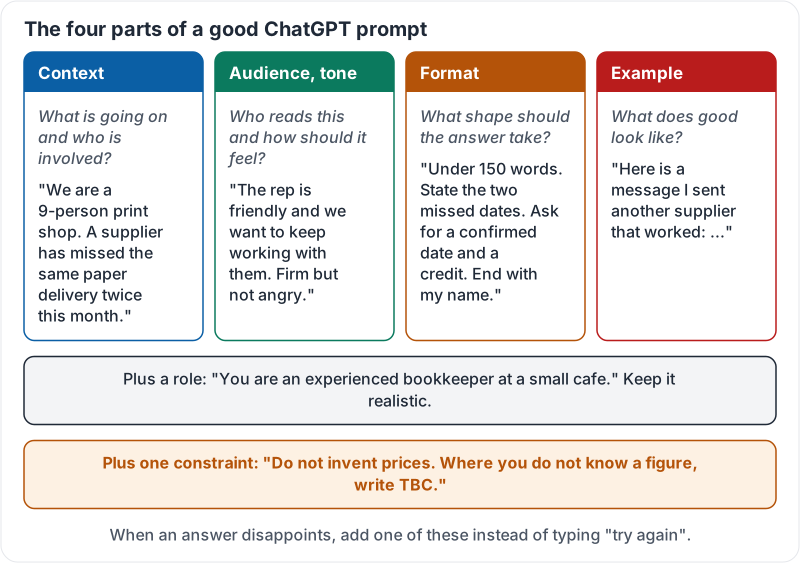
Four parts of a good prompt
| Part | What it gives | Example |
|---|---|---|
| Context | The situation and who is involved | “We are a 9-person print shop. A supplier has missed the same paper delivery twice this month.” |
| Audience and tone | Who reads it and how it should feel | “The supplier rep is friendly and we want to keep working with them. Firm but not angry.” |
| Format | The shape of the answer | “Under 150 words. State the two missed dates. Ask for a confirmed date and a credit. End with my name.” |
| Example | What good looks like | “Here is a message I sent another supplier that worked: …” |
Not every prompt needs all four. But when an answer disappoints, the fix is to add one of them. “Try again” rarely helps because ChatGPT has no new information to work with.
Role and constraints
Giving ChatGPT a role sharpens its choices: “You are an experienced bookkeeper at a small café.” Keep the role realistic.
Constraints matter as much as goals. Say what it must not do: “Do not invent prices. Where you do not know a figure, write TBC.” This single sentence prevents a large share of real-world mistakes.
The four parts, the role, and the constraint in one picture:
Show it an example
One pasted example beats a paragraph of description. Want product descriptions in your voice? Paste two you like and say “match this”. Want a table a certain way? Paste one row.
Follow up one change at a time
The first answer starts a conversation. Good follow-ups change one thing:
- “Shorter. Cut the opening line.”
- “You assumed we deliver. We don’t. Redo for collection only.”
- “Give me two more versions of the subject line.”
- “Make the ask clearer and move it to the first paragraph.”
Changing five things at once means you cannot tell what fixed it or what broke it.
Before and after
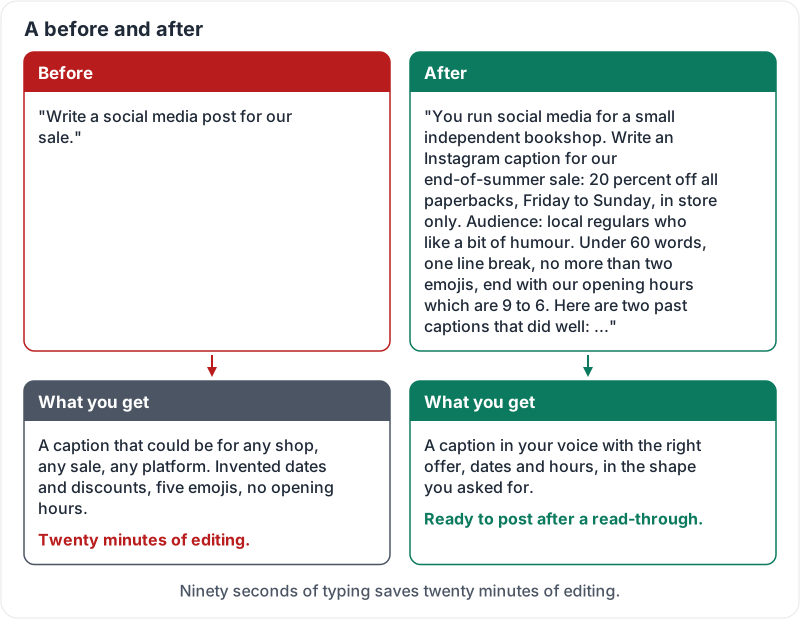
Before: “Write a social media post for our sale.”
After: “You run the social media for a small independent bookshop. Write an Instagram caption for our end-of-summer sale: 20 percent off all paperbacks, Friday to Sunday, in store only. Audience: local regulars who like a bit of humour. Under 60 words, one line break, no more than two emojis, end with our opening hours which are 9 to 6. Here are two past captions that did well so you can match the voice: …”
Ninety seconds of typing saves twenty minutes of editing.
The bookshop caption, before and after:
Try it now
Pick a message you need to send this week. Write the prompt with all four parts, including one pasted example of your own writing and one “do not” constraint. Compare the result with what a one-line prompt gives you.
Remember: context, audience, format, example, plus one sentence on what it must not invent. When the answer is wrong, add information instead of asking again.
Checking your progress…