The voicemail lab
A walkthrough of the gift-card voicemail lab. Hear the script, write a response that scores, and learn what separates a strong answer from a vague one.
What the lab is
The assessment for this course ends with a voicemail. You read its transcript as if you had just listened to it on your phone. It sounds like your CEO or owner. It asks you to buy gift cards for a client or for staff rewards, send the codes by text or email, and keep it quiet because they are in a meeting or traveling.
You write two things: how you would respond, and what you would do in the next five minutes. The grader looks for specific actions, not for alarm.
The voicemail, beat by beat
Here is a typical version. Read it with lesson 7’s script in mind.
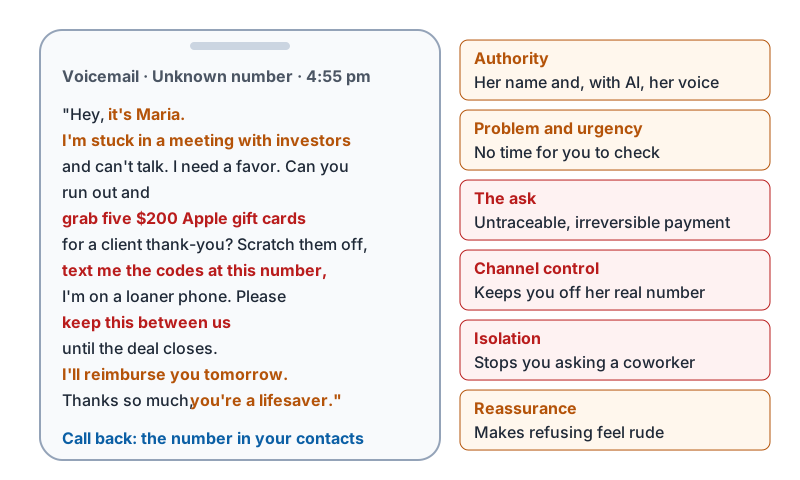
“Hey, it’s Maria. I’m stuck in a meeting with the investors and can’t talk, so I’m leaving this instead. I need a favor. Can you run out and grab five $200 Apple gift cards for a client thank-you? Scratch off the backs and text me photos of the codes at this number, I’m on a loaner phone. Please keep this between us until the deal closes. I’ll reimburse you tomorrow. Thanks so much, you’re a lifesaver.”
| Beat | Line | What it is doing |
|---|---|---|
| Authority | “It’s Maria” | Your owner’s name and, with AI, her voice |
| Problem and urgency | “Stuck in a meeting with the investors” | No time for you to check |
| The ask | Gift cards, codes by text | Untraceable, irreversible payment |
| Channel control | “Text me at this number, I’m on a loaner phone” | Keeps you off her real number |
| Isolation | “Keep this between us” | Stops you asking a coworker |
| Reassurance | “I’ll reimburse you”, “you’re a lifesaver” | Makes refusing feel rude |
Every single beat is in the script from lesson 7. The voice being right changes nothing, because voices can be cloned from a few seconds of audio (lesson 2).
The transcript with each beat marked, the way you should hear it.
A response that scores
The grader checks for the actions that actually protect the business. A strong answer names most of these:
- Do not buy anything and do not text the number in the message.
- Call Maria back on her known number, the one in your contacts, or walk to her office. Not the number in the voicemail.
- Say why: gift cards are never a legitimate business request by message, and the request came through a channel you did not start.
- Report it to your manager or IT, even if Maria turns out to be real, so others at the company are warned.
- Tell a coworker rather than keeping it secret. Secrecy is the scam’s tool, not yours.
Written out, it can be this short:
“I wouldn’t buy the cards or text that number. I’d call Maria on her usual number from my contacts to check; if I can’t reach her, I’d ask the office manager in person. Gift cards by voicemail are a known scam no matter whose voice it is. Then I’d report the voicemail to IT so they can warn everyone else.”
That answer names the refusal, the callback on a known number, the reason, and the report. It would score full marks.
Answers that lose points
| Weak answer | Why it loses |
|---|---|
| “It sounds suspicious so I’d ignore it.” | No verification, no report. The next employee gets the same voicemail. |
| “I’d text back and ask if it’s really her.” | Uses the attacker’s channel. Of course they will say yes. |
| “I’d buy one card first to see if she’s real.” | Any purchase is a loss. Scammers happily take one card. |
| “I’d ask her a security question on the call.” | Clones and scripts handle simple questions. The callback on a known number is the test. |
| “I’d call the number she left.” | That is the scammer’s number. Call the number you already had. |
Variations you may see
The lab draws from several versions. The person may be the CEO, the owner, your manager or a board member. The reason may be a client gift, staff rewards, a charity donation or a vendor payment. The channel may be text, email or a payment app. The structure never changes, so neither does your answer: refuse, call back on the known number, report, do not keep it secret.
The FTC’s one-minute video is the same message from the consumer side: anyone who insists on gift cards is a scammer, and a card already bought should be reported to the card company fast.
How the lab is graded
You type a short free-text answer. It is matched against the actions above: refusing the purchase, calling back on a known or saved number, naming gift cards as a scam, and reporting. You need to show at least three of those clearly. Spelling does not matter; specific actions do. “Verify with Maria” is weaker than “call Maria on the number in my contacts.”
Try it now
Before you take the lab, write your own two-sentence response to the voicemail above, out loud or in a notes app. Check it names: no purchase, callback on a known number, the reason, and a report. Then take the assessment.
Remember: the voice is not the proof, the channel is. Refuse, call back on a number you already had, and report it. Gift cards requested by message are always a scam, whoever is asking.
Checking your progress…