Web search, citations and artifacts
Search gives Claude fresh facts and a source to point at. Artifacts turn a chat into a document you can hand to someone else.
Two kinds of knowledge
Claude knows two different things. It has training knowledge, which is broad but frozen at a point in the past, and it can do web search, which is current but only as good as the pages it finds.
Ask “what are the current rules for food truck permits in our county” without search and you may get an answer that was true two years ago. Ask with search on and you get an answer plus links. The links are the point.
Why citations matter more than the answer
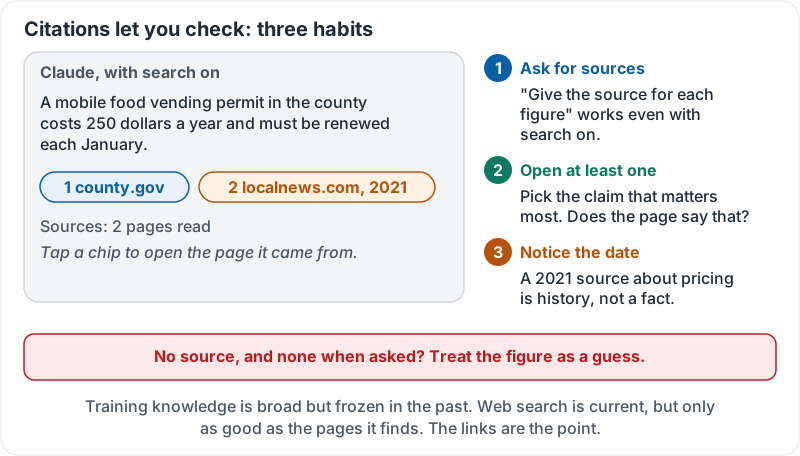
A citation lets you check. When Claude says “the permit costs 250 dollars” and links to the county page, you click, you confirm, you are done in ten seconds. Without the link you are trusting a confident sentence.
Make a habit of three things:
- Ask for sources. “Give the source for each figure” works even when search is already on.
- Open at least one. Pick the claim that matters most and read the page. Does it actually say that?
- Notice the date. A source from 2021 about pricing is a historical document, not a fact.
If Claude gives a figure with no source and cannot find one when asked, treat the figure as a guess.
What a searched answer looks like, and the three habits applied to it:
When to switch search on and off
| Use search when… | Leave it off when… |
|---|---|
| The answer depends on something recent (prices, laws, product details, news) | You are editing your own text |
| You need a source to show someone | You are brainstorming or drafting |
| You are checking a claim someone made | The content is already in your uploaded files |
Search also costs a little time per answer, so do not leave it on for everything.
Artifacts: from chat to document
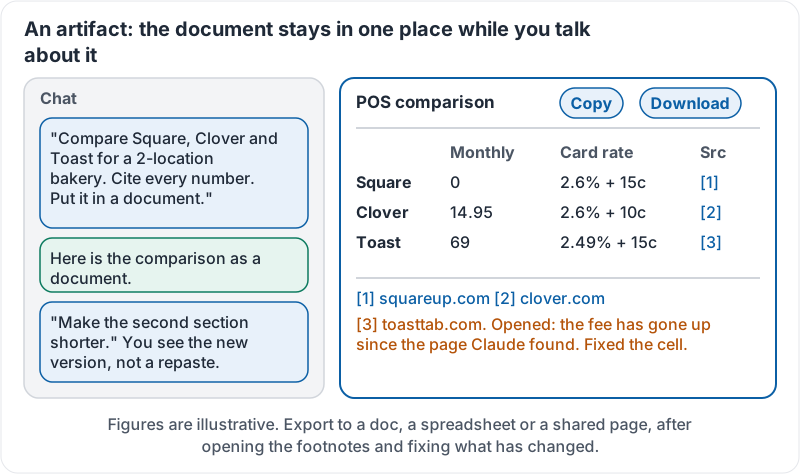
When you ask for something substantial, such as a one-page policy, a table, a checklist or a simple web page, Claude can show it in a separate panel called an artifact rather than as a wall of chat text. You can edit it, ask for changes, and copy or download the result.
Artifacts are useful because:
- The document stays in one place while you talk about it.
- You can ask for a change (“make the second section shorter”) and see the new version, not a repeated paste.
- The result is something you can export to a doc, a spreadsheet or a shared page.
Chat on one side, document on the other:
A short demonstration of artifacts being created and shared from a chat:
A worked example
Theo needs a one-page comparison of three point-of-sale systems for the owner. He asks Claude with search on: “Compare Square, Clover and Toast for a 2-location bakery. Table with monthly fee, card rate, hardware cost and contract length. Cite the source for every number. Put it in a document I can download.”
He gets an artifact with a table and footnotes. He opens two footnotes, finds one price has gone up since the page Claude found, fixes that cell, and sends it. Twenty minutes instead of two hours.
Try it now
Ask Claude, with search on, one factual question about your industry that could have changed in the last year. Open the first source it cites and confirm the page really says what Claude said. Then ask for the answer as a short artifact.
Remember: search gives fresh facts, citations let you check them, artifacts give you a document. Always open at least one source.
Checking your progress…