Lab: a meeting brief from a PDF
Put the course to work. Build a one-page meeting brief from a PDF, then find the claim in ChatGPT's brief that the document does not support.
The job
Your manager forwards a supplier’s proposal as a PDF and says “give me a one-pager for Thursday’s meeting”. You will use ChatGPT to build the brief, then catch the claim it adds that the PDF never made. The assessment at the end of this course gives you a brief of this kind to critique.
The document
Imagine a six-page PDF from a cleaning contractor, Brightside Facilities, proposing a contract for your two offices. The parts that matter:
- Page 2: monthly fee 2,300 for both sites, five visits a week, 12-month term.
- Page 3: “We aim to respond to service issues within 24 hours.”
- Page 4: supplies included except consumables (paper towels, soap), which are billed at cost.
- Page 5: “Our team is background-checked on hire.”
- Page 6: 30-day notice to cancel after month six; before that, three months’ fees are due.
Notice what the PDF does not say: nothing about insurance, nothing about a guaranteed response time, nothing about how often background checks are refreshed.
Step 1: brief ChatGPT properly
Weak: “Summarise this.”
Strong, using lesson 2 and lesson 3:
“You are preparing a one-page brief for the owner of a 20-person company who will decide on Thursday whether to sign this cleaning contract. Use only what is in the attached PDF. Sections: What is proposed, Costs, Commitments they make, Our exit terms, Open questions to ask them. Where the PDF is silent on something an owner would want to know, list it under Open questions rather than guessing. Under 300 words. For every figure, note the page number.”
Upload the PDF and send.
Step 2: read the brief against the PDF
Suppose ChatGPT returns, in part:
Commitments they make. Brightside guarantees a 24-hour response to any service issue (p. 3). All staff are background-checked annually (p. 5). Brightside carries full liability insurance covering both sites.
Our exit terms. 30 days’ notice after month six (p. 6).
Run the lesson 6 check:
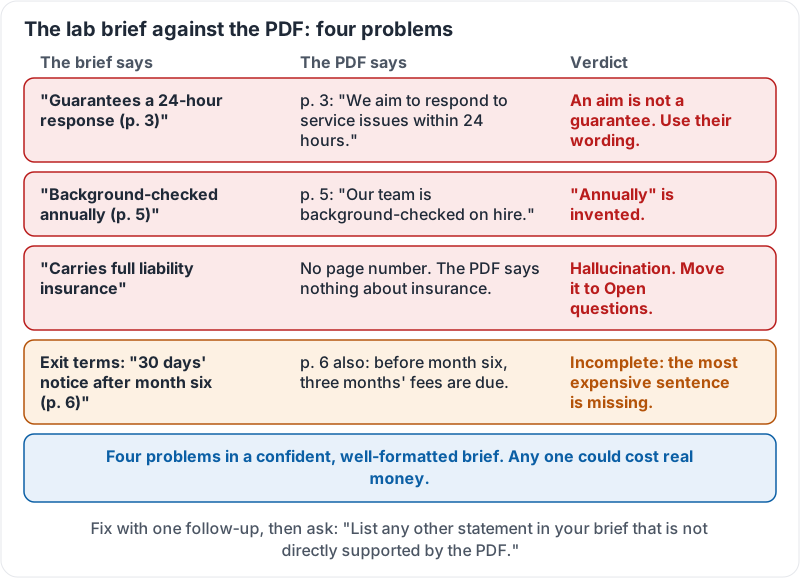
- “Guarantees a 24-hour response.” The PDF says “aim to respond”. An aim is not a guarantee. This is an unsupported claim that would change how the owner negotiates.
- “Background-checked annually.” The PDF says “on hire”. “Annually” is invented.
- “Carries full liability insurance.” No page number, and the PDF says nothing about insurance. This is a hallucination. It belongs under Open questions.
- Exit terms is incomplete: it leaves out the three-months’ fees penalty before month six, which is the most expensive sentence in the document.
Four problems in a confident, well-formatted brief. Any one of them could cost real money.
The brief against the PDF, line by line:
Step 3: fix with one follow-up
“Corrections: page 3 says ‘aim to respond’, not guarantee; use their wording. Page 5 says checked on hire, not annually. Remove the insurance line; the PDF does not mention insurance, so add it to Open questions. Under exit terms, add the early-cancellation penalty from page 6. Then list any other statement in your brief that is not directly supported by the PDF.”
The second version is right, and the last sentence usually turns up one more thing.
Try it now
Take a real PDF from your work, a proposal, a policy or a report, and brief ChatGPT with the strong prompt pattern above, including “use only what is in the attached document” and “note the page for every figure”. Check every claim in the Commitments section against the page it cites.
Remember: tell it to use only the document and to list gaps as questions, not guesses. Then find the sentence in the source for every claim that would change a decision.
Checking your progress…