AI safety and judgment, part 2: hallucinations, bias, copyright and policy
ChatGPT can be confidently wrong, quietly unfair, or borrow someone else's work. Know the four risks and the one-line disclosure habit.
Hallucinations: confident and wrong
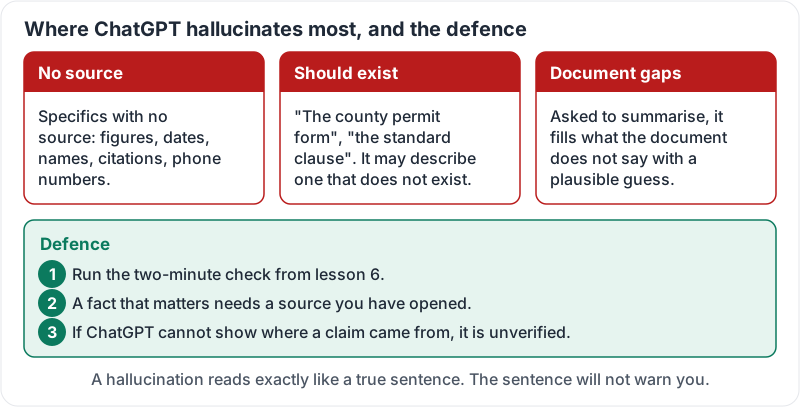
A hallucination is an answer that sounds right and is not. ChatGPT may invent a statistic, a quote, a legal requirement, a product feature, a citation or a person. It does not warn you. The sentence reads exactly like a true one.
Where they happen most:
- Specifics with no source: figures, dates, names, references, phone numbers.
- Things that should exist: “the standard form”, “the usual clause”. It may describe one that does not exist.
- Gaps in a document: when summarising, it fills what the document does not say with a plausible guess.
The defence is the two-minute check from lesson 6 plus one rule: a fact that matters needs a source you have opened. If ChatGPT cannot show where a claim came from, it is unverified.
The three hotspots and the defence, together:
Bias: quietly unfair
ChatGPT learned from human writing, which carries human assumptions. Unchecked, AI drafts can:
- Assume a nurse is “she” and a mechanic is “he”.
- Rank job applicants on names, schools or career gaps rather than skills.
- Write more warmly to one customer than another based on a name or address.
Two habits. Never let the AI decide about a person: hiring, firing, pricing, credit, housing, discipline. Use it to draft and organise; a person decides. And when you ask for anything that compares people, ask ChatGPT to list the criteria it used, then check them.
Copyright: whose work is this?
Output you create at work is generally yours to use, with two cautions:
- Do not ask it to reproduce someone else’s work. “Rewrite this competitor’s brochure so it’s ours” is a copyright problem whoever types it.
- Images: no other companies’ logos, characters or products, no real people without consent (lesson 5).
If a long passage reads like a quote from a real book, article or song, assume it may be one and do not publish it.
Your company AI policy
Most small businesses now have a short AI policy. It usually says:
- Which tools and accounts are approved.
- What may be pasted (the three buckets from part 1).
- Which tasks need a human decision.
- When AI use must be disclosed.
If you have not read yours, ask for it today. If there is none, the rules in these two lessons are a safe default.
Disclosure: the one-line habit
| Situation | Disclose? | How |
|---|---|---|
| Internal draft you edited and own | Usually no | It is your work |
| Customer-facing text you edited and checked | Follow policy | Often no, as long as a person reviewed it |
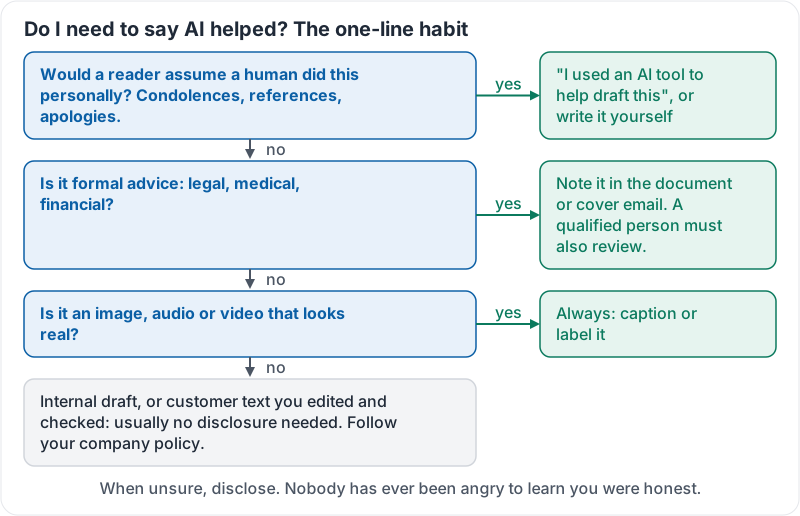
| Anything a reader assumes you wrote personally: condolences, references, apologies | Yes, or write it yourself | “I used an AI tool to help draft this” |
| Formal documents: legal, medical, financial | Yes, and a qualified person reviews | Note in the document or cover email |
| Images, audio or video that look real | Yes, always | Caption or label |
When unsure, disclose. Nobody is upset to learn you were honest.
The same rules as a quick decision path:
Try it now
Find your company AI policy, or ask who owns it. Compare it with lessons 7 and 8 and note one thing it adds and one thing it misses. If there is no policy, write three sentences that could start one and send them to your manager.
Remember: a fact that matters needs a source you opened, people decisions stay with people, do not borrow others’ work, and disclose when a reader would want to know.
Checking your progress…